OpenAI Is Now Running Ads Here’s What Every Brand Needs to Know
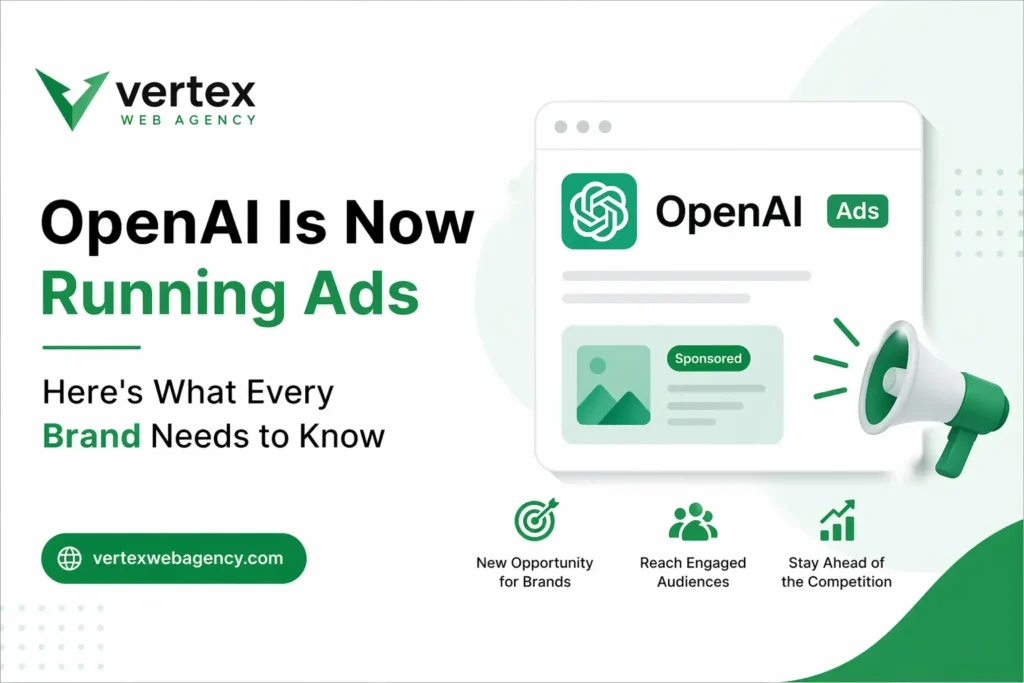
The age of advertising inside AI-powered experiences has officially begun. Here’s why it matters and what smart marketers should do next.
For years, AI platforms have operated on a simple promise: no ads, no clutter, just intelligent answers. That era is now quietly coming to an end.
OpenAI the company behind ChatGPT, one of the world’s most widely used AI tools has begun rolling out advertisements to users on its Free and Go plans, starting in Australia, New Zealand, and Canada. This isn’t a rumor or a leaked roadmap. It’s happening right now, and it marks a turning point in how brands can reach audiences inside AI-driven experiences.
At Vertex Web Agency, we believe this is one of the most significant digital marketing developments of 2026. Here’s everything you need to know.
What Exactly Is OpenAI Doing with Ads?
OpenAI’s ad rollout is deliberate and carefully controlled at least for now. The company is introducing advertisements specifically on two of its lower-tier access plans: the Free plan and the Go plan. These are the tiers used by the vast majority of everyday ChatGPT users who haven’t upgraded to a paid subscription.
Crucially, premium paid tiers including Pro, Business, Enterprise, and Education will remain completely ad-free. This signals that OpenAI is drawing a clear line: ads are a trade-off for free access, not a feature of the premium experience.
The initial markets targeted are Australia, New Zealand, and Canada, suggesting OpenAI is testing its advertising model in English-speaking markets with mature digital ad ecosystems before expanding globally.
Why This Is a Big Deal for Digital Marketers
If you work in digital marketing, SEO, paid media, or brand strategy, you should be paying close attention to this development. Here’s why.
1. A brand-new advertising channel is opening up. Conversational AI is where hundreds of millions of people now go to search, research, and make decisions. Advertising inside that experience at the moment when a user is actively seeking information is arguably more valuable than a traditional display ad or even a Google search ad. The intent signal is incredibly strong.
2. AI-powered search is reshaping discovery. Traditional SEO and paid search are already being disrupted by AI-generated answers. As OpenAI introduces ads into its interface, it could reshape how brands compete for visibility in AI-driven search and discovery. Getting familiar with this channel early gives you a first-mover advantage.
3. Conversational ad formats are uncharted territory. Nobody fully knows yet how ads will look and feel inside a chat interface. Will they appear as sponsored responses? Sidebar placements? Contextual recommendations? This ambiguity is actually an opportunity brands that experiment now will have a head start when the format matures and scales globally.
The Bigger Picture: Why Is OpenAI Doing This?
OpenAI is one of the most heavily funded tech companies in the world, but building and running frontier AI models is extraordinarily expensive. The company has long relied on a combination of subscription revenue (ChatGPT Plus, Pro, Business) and enterprise API contracts to fund its operations.
Introducing advertising makes strategic sense for several reasons:
Expanding revenue streams. Subscriptions alone can’t fund the scale of infrastructure and research that OpenAI is running. Advertising opens up an enormous new revenue channel one that has funded the entire internet economy for decades.
Unlocking value from free users. Millions of people use ChatGPT for free every day. Without ads or conversion to paid plans, those users generate no direct revenue. Ads change that equation.
Testing how advertising fits in AI. OpenAI isn’t just flipping an ad switch it’s exploring how advertising integrates into a conversational interface without destroying the user experience. The limited rollout to select markets is a controlled experiment, not a global launch.
What This Means for the Future of AI Advertising
The implications of OpenAI entering the ad market go well beyond ChatGPT. This move is likely to trigger a broader shift across the AI platform landscape.
Other major AI players including Google with Gemini, Microsoft with Copilot, and emerging competitors will be watching OpenAI’s ad experiment closely. If it proves effective without alienating users, expect ads to become a standard feature across AI tools and assistants.
We’re potentially looking at the birth of a new advertising category: conversational AI advertising placements that appear not on a webpage or search results page, but within an active, intelligent dialogue between a user and an AI system.
For brands, this could eventually mean:
- Sponsored answers to product-related questions
- Contextual brand recommendations during research conversations
- AI-generated ad content that fits seamlessly into the chat experience
- New attribution models built around conversation-based engagement
The Trade-Off: Ads vs. Premium Experience
One of the most interesting aspects of OpenAI’s strategy is how deliberately it is segmenting its user base. By keeping paid tiers completely ad-free, OpenAI is reinforcing a powerful value proposition: pay to remove ads and get a better experience.
This is the same model that has worked for Spotify, YouTube, and dozens of other platforms. It creates a natural upgrade path users who find ads disruptive are motivated to subscribe. And it keeps the premium product aspirational and clean.
For advertisers, this means the free-plan audience is likely to skew toward more casual users, younger demographics, and markets where the paid plan isn’t yet the norm. Understanding your target audience and whether they’re likely to be on a free or paid plan will matter when planning AI ad campaigns.
What Should Brands and Marketers Do Right Now?
You don’t need to run AI ads today to benefit from this shift. But there are steps smart marketers should be taking now to prepare.
Stay informed about the rollout. OpenAI’s ad expansion will move fast once it proves viable. Follow updates on which markets and plan tiers are included, and what ad formats are being tested.
Think about your presence inside AI interfaces. Whether or not you’re running paid ads, how your brand appears in AI-generated answers matters. This is the new frontier of brand visibility sometimes called Generative Engine Optimization (GEO) and it’s becoming as important as traditional SEO.
Start conversations with your agency about AI advertising strategy. The brands that will win in AI advertising are those that develop their strategy early, test formats when they’re new, and build expertise before the channel becomes crowded.
Audit your content for AI discoverability. AI models learn from the web. Ensuring your website content is clear, authoritative, and well-structured helps your brand appear in AI-generated responses paid or organic.
Final Thoughts: A Cautious Entry with Big Implications
OpenAI’s move into advertising is measured, calculated, and for now limited in scope. But it represents a fundamental shift in the economics of AI platforms and the possibilities for digital advertising.
The question isn’t whether AI advertising will become mainstream. It’s how fast it will get there, and whether your brand will be ready.
At Vertex Web Agency, we help brands navigate emerging digital channels from SEO and paid media to the cutting edge of AI-powered marketing. If you want to understand how developments like OpenAI’s ad rollout could affect your visibility, strategy, or budget, we’d love to talk.
