
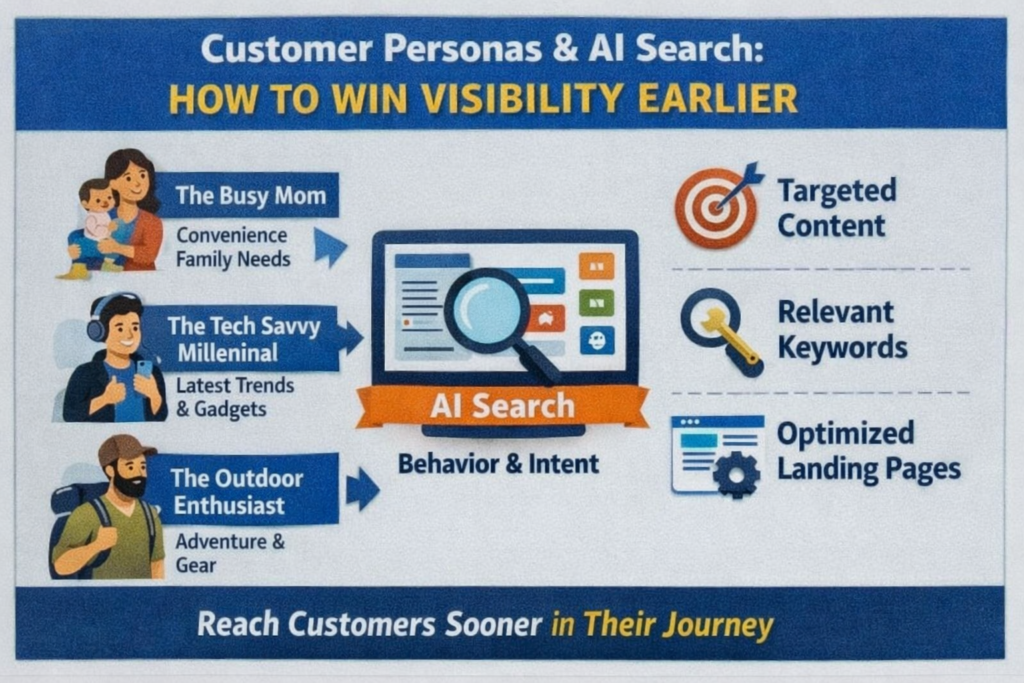
Customer Personas & AI Search: How to Win Visibility Earlier
VERTEX WEB AGENCY | SEO & CONTENT STRATEGY INSIGHTS
How Customer Personas Help You Win in AI Search — Before Your Competitors Even Enter the Conversation
Generic content gets ignored by AI search engines. Persona-driven content gets cited, recommended, and trusted. Here’s why the difference matters and how to make the shift.
At Vertex Web Agency, one of the most consistent content marketing problems we see is this: businesses invest time and budget into creating content, but it never gains traction. It doesn’t rank well on Google. It doesn’t get cited by AI tools like ChatGPT or Google’s AI Overviews. And more importantly, it doesn’t reach buyers at the moments that matter most.
The root cause is almost always the same the content is too generic. It answers broad category-level questions instead of the specific, situation-driven questions that real buyers are actually asking.
As AI-powered search fundamentally changes how people discover products, services, and information, this gap between generic content and persona-driven content has never been more consequential. In this guide, Vertex Web Agency explains why customer personas are the key to winning visibility in AI search and exactly how to use them to build a content strategy that reaches buyers earlier in the decision process.
The Problem with Generic Content in an AI-Driven World
Most content marketing strategies start from the wrong place. When a marketing team sits down to brainstorm blog topics or website content, they typically start with their products or services and ask: “What broad questions can we answer about what we do?”
The result is predictable. Content that looks like this:
- What is CRM software?
- What is marketing automation?
- What is a warehouse management system?
These are reasonable questions on the surface. But they share a critical flaw: no real buyer actually searches for them. More importantly, no AI assistant is going to recommend your specific content to answer them because dozens of high-authority websites have already answered these questions, and your version offers nothing different.
Real buyers don’t search for textbook definitions. They search for solutions to problems they are personally experiencing right now. Their actual questions look more like:
- What CRM is best for a small 10-person sales team with a tight budget?
- Why are qualified leads falling through the cracks in our pipeline?
- How do I fix slow picking speeds in a mid-sized warehouse operation?
The difference is not subtle. The second set of questions includes a person and a problem. That context completely changes what useful content looks like and dramatically increases your chances of appearing in AI-generated responses.
Why AI Search Rewards Persona-Driven Content
Search behaviour has undergone a fundamental shift. Instead of typing short, fragmented keyword phrases into a search engine, buyers are increasingly asking detailed, conversational, context-rich questions to AI assistants ChatGPT, Google AI Overviews, Perplexity, and Microsoft Copilot.
A query that once looked like “best CRM software” might now look like:
“We’re a 12-person B2B sales team and we’re losing deals because our pipeline tracking is a mess. We need a CRM that’s simple to adopt and integrates with our email. What should we look at?”
In response, the AI doesn’t just return a list of links. It explains the problem, evaluates options, and recommends solutions functioning less like a search engine and more like a knowledgeable consultant.
Here is what this means for your content strategy: if your content clearly explains why a specific type of buyer experiences a specific problem, and how to solve it, you dramatically increase the probability that your explanation shapes how the AI understands and answers that question.
You’re not just competing for a ranking position anymore. You’re competing to be part of the conversation and the earlier you enter that conversation, the more likely you are to stay in it as the buyer’s thinking evolves.
How Conversational AI Search Works: A Real Example
Consider how a buyer’s AI search conversation might unfold when planning something as simple as a day out:
- They start broad: “I need ideas for things to do in a city for a group of friends in their 50s.”
- The AI offers general suggestions. One catches their interest, so they follow up: “Tell me more about the gaming arcades you mentioned.”
- Based on that response, they narrow further: “What else is there to do near that area food and drinks specifically?”
By the end of the conversation, the AI has built a tailored, specific recommendation. The businesses that got recommended were the ones whose content reflected that specific persona their age group, their interests, their context.
The same dynamic applies in B2B and ecommerce. Brands that create content speaking directly to a defined buyer persona and their specific problem are far more likely to be referenced by AI tools at each stage of this conversational journey. Brands that only publish generic category content are invisible to this process.
What Customer Personas Are (and What They’re Not)
A customer persona — sometimes called a buyer persona — is a semi-fictional representation of a specific segment of your target audience. It defines not just who that customer is demographically, but what they are responsible for, what problems they face, and what questions they ask when those problems occur.
Personas are not complicated marketing documents reserved for large enterprises. At their most useful, a persona answers three simple questions:
| Question 1 | Question 2 | Question 3 |
| What are they responsible for? | What problems make that difficult? | What would they type into Google or an AI assistant when that problem hits? |
| e.g. Hitting sales targets. Generating marketing leads. Running efficient warehouse operations. | e.g. Missed sales targets. Slow warehouse processes. Poor lead tracking. High customer churn. | e.g. “Why are leads slipping through our CRM?” or “How do I improve warehouse picking speed?” |
Answer these three questions for each major customer segment you serve, and you have everything you need to generate persona-driven content ideas that will outperform generic content in AI search.
Persona-Driven Content vs. Generic Content: A Side-by-Side Comparison
The best way to illustrate the power of personas in content strategy is to compare generic questions with their persona-driven equivalents across the five core content categories a framework borrowed from the “They Ask, You Answer” (TAYA) methodology.
| Content Category | Generic Question | Persona-Driven Question |
| Cost / Pricing | How much does CRM software cost? | What does a CRM cost for a 10-person B2B sales team on a growth budget? |
| Problems | What problems do warehouse management systems solve? | Why do warehouse managers struggle with picking accuracy in high-SKU environments? |
| Comparisons | HubSpot vs. Salesforce | HubSpot vs. Salesforce for a small marketing team running inbound campaigns |
| Best Of | Best CRM systems | Best CRM for a growing SME sales team with no dedicated IT support |
| Reviews | Salesforce review | Is Salesforce worth the cost for a mid-size B2B organisation? |
The topic hasn’t changed in any of these examples. But the question now reflects a real buyer’s reality their role, their company size, their situation. This is the difference between content that exists and content that influences decisions.
Why Persona-Driven Content Performs Better in AI Search: 3 Reasons
1. It Mirrors How Buyers Actually Think and Search
People don’t open Google or ChatGPT to look for textbook definitions. They search because they have a problem. Personas anchor your content in that problem ensuring every piece of content you create is connected to a real buying situation rather than a product category.
When AI tools encounter content that speaks directly to a defined buyer situation, they are far more likely to use it as a source when generating responses to similar queries. Generic content that explains what a product is gets passed over. Content that explains why a specific type of buyer has a specific problem and how to solve it gets cited.
2. It Produces More Useful, Higher-Quality Content
When you know exactly who a piece of content is for, everything about it improves. The examples become more relevant. The advice becomes more practical. The language becomes more precise. Rather than writing something that vaguely applies to everyone, you write something that is genuinely valuable to one clearly defined person.
This quality signal is increasingly important. AI systems are trained to evaluate content by how well it serves the intent behind a query. Persona-driven content, almost by definition, serves intent more precisely than generic content.
3. It Aligns With How AI Explains Problems
AI assistants have a consistent pattern when answering complex questions: they begin by explaining the problem, then outline the solution, and finally suggest specific options. Content that clearly describes why a particular buyer persona experiences a particular challenge fits neatly into this pattern.
If your content already explains “why small B2B sales teams lose deals in their CRM” in precise detail, there is a strong chance an AI will draw on that explanation when a user asks a question about exactly that problem. You’re not just optimising for a keyword you’re shaping the AI’s understanding of the problem itself.
The Most Common Mistake: Starting With Your Product
One of the most consistent content strategy errors we see at Vertex Web Agency is businesses building their entire content plan around their products and services rather than their buyers’ problems.
It makes intuitive sense from a company’s perspective of course you want to talk about what you offer. But buyers don’t start their journey with your product. They start with a problem. And if your content doesn’t meet them at the problem, they’ll find another source that does — whether that’s a competitor’s blog, a review platform, or an AI-generated answer that doesn’t mention you at all.
Personas force a perspective shift. Instead of asking “What should we say about our product?”, you start asking “What problem is our buyer experiencing right now, and what do they need to understand to move forward?” That shift, simple as it sounds, is what separates content that gets read and trusted from content that fills a page and nothing more.
How to Apply This Strategy: A Practical Starting Point
You don’t need a sophisticated persona research project to begin. Start with what you already know about your best customers and work through this exercise for each key segment:
- Identify 3–5 distinct customer types you serve (by role, industry, company size, or challenge)
- For each persona, list what they are accountable for in their job or business
- List the specific problems that make those responsibilities difficult to achieve
- For each problem, write down the question that person would type into Google or ask an AI assistant
- Map those questions to your five core TAYA content categories: cost, problems, comparisons, best-of, and reviews
- Prioritise the questions where you have genuine expertise and your competitors have weak or generic coverage
The output of this exercise isn’t just a list of blog topics. It’s a content strategy that is directly mapped to how your buyers think, search, and make decisions — and that is precisely the kind of content AI search tools surface, cite, and recommend.
The Vertex Web Agency Takeaway
AI search is not just changing where buyers find information it’s changing when in the buying process they form their opinions and narrow their choices. Brands that show up early in these AI-driven conversations, with content that speaks directly to a buyer’s specific problem and situation, will win visibility, trust, and consideration long before a competitor even enters the picture.
Customer personas are the tool that makes this possible. They turn vague topic lists into precise, useful content. They align your content strategy with how real buyers think and ask questions. And they increase the probability that AI tools from ChatGPT to Google’s AI Overviews will draw on your content when forming their answers.
At Vertex Web Agency, we help businesses build persona-driven content strategies that are built to perform in both traditional and AI-powered search. If your content isn’t generating the visibility or leads it should, get in touch with our team for a content strategy consultation.
