
Google Ads Attribution Windows: 7-Day vs 30-Day Click Window
VERTEX WEB AGENCY | GOOGLE ADS & PPC INSIGHTS
Most Google Ads accounts are running a 30-day attribution window by default and never questioning it. Here’s why that default setting could be distorting your data, inflating channel performance, and costing you real ad spend.
At Vertex Web Agency, we audit Google Ads accounts every week. One of the most overlooked settings we consistently find misconfigured is the conversion attribution window. It’s a setting that quietly shapes every bidding decision your campaigns make yet most advertisers set it once and forget it forever.
The default 30-day click attribution window in Google Ads was designed for industries with longer consideration cycles. But what if your customers convert in two days? You’re not just measuring wrong you’re feeding your Smart Bidding algorithm stale, overlapping signals that inflate reported performance and muddy the picture across every channel you run.
In this case study-style guide, Vertex Web Agency breaks down exactly what happened when we tested a 7-day click attribution window and what the results reveal about how your attribution settings may be affecting your Google Ads ROAS, bidding strategy, and cross-channel clarity.
What Is a Google Ads Attribution Window and Why Does It Matter?
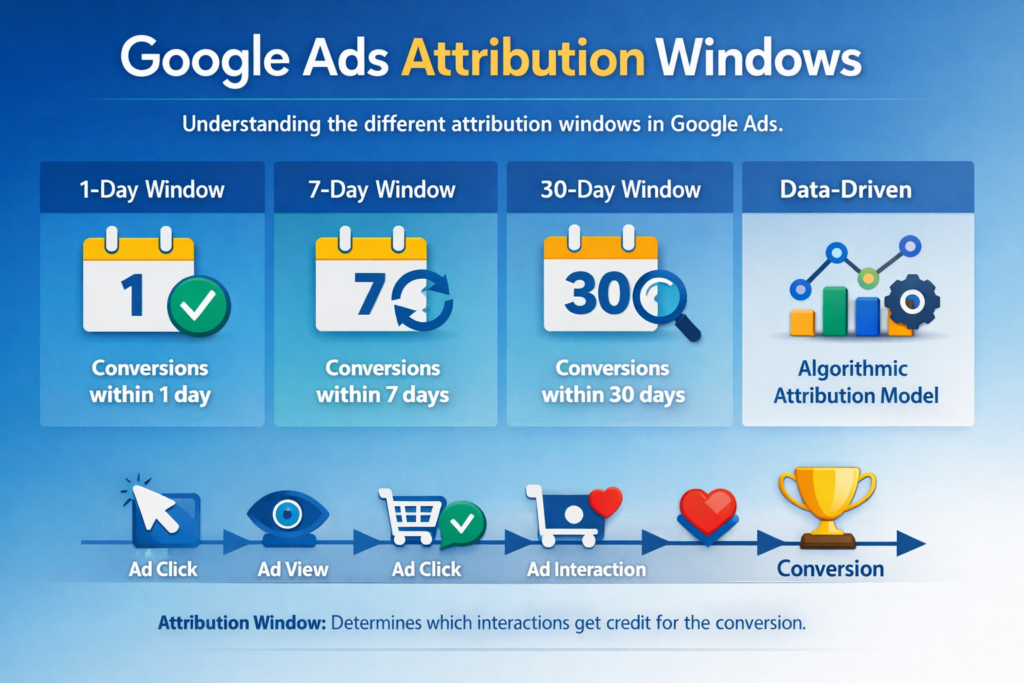
A conversion attribution window defines how many days after a click Google Ads will credit a conversion to that click. With a 30-day window, if a user clicks your ad today and purchases 28 days later, that sale is attributed to today’s click.
This makes sense for high-consideration purchases software subscriptions, B2B services, or luxury products where buyers research for weeks. But for ecommerce and impulse-driven products, a 30-day window creates serious problems:
- Over-attribution: Google Ads claims credit for sales that were influenced by other channels (like Meta Ads) closer to the purchase
- Cross-channel duplication: Both Google and Meta report the same sale, inflating the apparent performance of both channels
- Smart Bidding inefficiency: Your automated bid strategy optimizes based on a bloated, delayed signal rather than actual buying behaviour
- Slower optimization loops: It takes weeks instead of days to know whether a campaign change is working
The Case for a 7-Day Attribution Window: A Real Account Test
We worked with a direct-to-consumer (DTC) ecommerce retailer competing in a fast-moving, high-competition market. Their average customer conversion window the time between first click and purchase was just 2.2 days. The vast majority of their conversions occurred within 24 hours of the initial ad interaction.
Despite this, their Google Ads account was running on a 30-day click attribution window. Meta Ads, naturally, claimed most of the sales due to higher budget allocation. But with Google’s 30-day window still active, Google was also claiming a significant share of those same conversions creating a reporting overlap that made it impossible to measure true incremental return on ad spend (ROAS) for either platform.
How We Approached the Attribution Window Test
Rather than immediately switching the primary conversion action which would trigger a Smart Bidding learning phase and potential volatility we took a phased, risk-managed approach:
- Step 1: Duplicated the primary purchase conversion action and set it to a 7-day click window as a secondary conversion
- Step 2: Ran both conversion actions in parallel for two weeks to compare reported performance side by side
- Step 3: Transitioned the 7-day version to the primary optimization conversion on January 12, 2026
This approach meant Smart Bidding had time to recalibrate gradually rather than experiencing an abrupt signal change. If you’re planning a similar test in your own Google Ads account, this phased rollout is the recommended method.
The Results: What Happened After Switching to 7-Day Attribution
After comparing 30 days post-change against the previous equivalent period, in-platform Google Ads metrics improved substantially:
| Metric | Change After 7-Day Window |
| Ad Spend (Cost) | Down 6.3% |
| Conversions Reported | Up 42.9% |
| Conversion Value | Up 52.1% |
| ROAS (In-Platform) | Up 62.3% ✓ |
| Total Shopify Sales | Up 20% |
| Net Business Profit | Up 30% |
It’s important to note: these improvements can’t be attributed solely to the attribution window change. Campaign restructuring, budget adjustments, and bid strategy refinements were happening in parallel. But critically, the change produced no negative performance impact and the improvement in signal quality was clear.
What Marketing Mix Modelling (MMM) Revealed
The most telling data came from marketing mix modelling (MMM), which measures the incremental contribution of each advertising channel independently of platform-reported metrics. After the attribution window switch:
- Google Ads incremental ROAS increased 10% — rising to 1.82
- Meta Ads incremental ROAS dropped 25% — falling to 0.59
This was the clearest signal of all. With a tighter attribution window, Google was no longer claiming delayed credit for conversions that other channels (particularly Meta) had influenced closer to purchase. The true incremental value of each platform became visible and it changed how the client allocated their advertising budget.
How a Shorter Attribution Window Improves Smart Bidding Performance
Google’s Smart Bidding strategies including Target ROAS, Maximise Conversions, and Maximise Conversion Value optimize based on the conversion signals your account sends. The quality, recency, and accuracy of those signals directly affects how well your automated bidding performs.
The Problem with 30-Day Signals
With a 30-day click window, Smart Bidding receives conversion data that is weeks old. This means:
- The algorithm reacts slowly to performance shifts including bid changes, seasonal demand swings, and budget moves
- Bidding decisions are calibrated on a bloated conversion pool that includes cross-channel duplicates
- ROAS targets become harder to hit accurately because the signal reflects a mix of actual Google-driven conversions and conversions from other channels
The Advantage of 7-Day Signals
A 7-day attribution window feeds fresher, cleaner data into Smart Bidding. This creates:
- Tighter feedback loops — the algorithm learns from recent buying behaviour, not last month’s data
- Faster campaign diagnostics — you can assess whether a budget or bid change is working within days, not weeks
- More accurate ROAS targets — automated strategies optimize against a signal that more closely reflects actual incremental conversions
- Better alignment between ad spend and real customer buying cycles
For DTC ecommerce brands, impulse-purchase categories, or any business where the average customer makes a decision within a week, this signal improvement can have a compounding effect on campaign performance over time.
When a 7-Day Attribution Window May NOT Be Right for You
Attribution window optimization is not a universal fix. Before changing your Google Ads conversion window, consider these important trade-offs:
Potential Short-Term Reported Performance Drop
Removing delayed conversion credit will almost certainly reduce your reported conversion volume initially even if actual sales haven’t changed. If your client, management team, or stakeholders aren’t briefed on this expected dip, it can create unnecessary concern or pressure to revert the change.
Smart Bidding Learning Phase
Any change to your primary conversion action triggers a Smart Bidding learning phase. During this period, automated bid strategies particularly Target ROAS and Max Conversion Value may behave unpredictably. Budget volatility, temporary ROAS swings, and fluctuating impression share are all possible. This phase typically lasts 1–2 weeks.
Not Suitable for Long Sales Cycles
If your customers take 2–4 weeks to research, compare, and convert as is common in B2B lead generation, high-ticket ecommerce, or financial services a 7-day window will undercount legitimate conversions. The result: suppressed reported ROAS, reduced conversion data for Smart Bidding, and potentially suboptimal bid decisions.
The rule of thumb: your attribution window should match your actual customer conversion window. To find this data in your own account, check the “Days to Conversion” report in Google Ads under Tools > Attribution.
How to Test Attribution Windows Safely in Your Google Ads Account
If you’re considering this change, here’s the step-by-step process Vertex Web Agency recommends:
- Analyze your conversion path data first check your average days to conversion and distribution of conversion timing
- Duplicate your primary conversion action with the new window and tag it as a secondary conversion
- Run both conversion actions in parallel for 2–4 weeks to benchmark reported differences
- Brief your stakeholders on the expected initial dip in reported conversions
- Switch the 7-day conversion action to primary only once you’re confident in the data
- Monitor Smart Bidding performance closely for the first 2 weeks post-switch
- Cross-reference with Shopify, GA4, or your backend sales data throughout not just in-platform metrics
The Vertex Web Agency Takeaway
Attribution settings are one of the most underestimated levers in Google Ads account management. When your attribution window doesn’t match how your customers actually buy, every optimization decision in your account from bids to budgets to campaign structure is built on a distorted foundation.
For this DTC ecommerce client, switching from 30-day to 7-day click attribution didn’t just improve reporting. It clarified channel contribution, improved Smart Bidding signal quality, and gave leadership the data confidence to make smarter ad investment decisions. The result was a 62% ROAS increase in-platform, 20% growth in total sales, and 30% improvement in net profit.
Unsure whether your Google Ads attribution settings are working for or against you? Vertex Web Agency offers Google Ads account audits and PPC strategy consultations. Get in touch today.
